
Does Your Book and Claim Certificate Actually Work Under SBTi v2?
Four Things to Check Before Counting it Towards Your Target
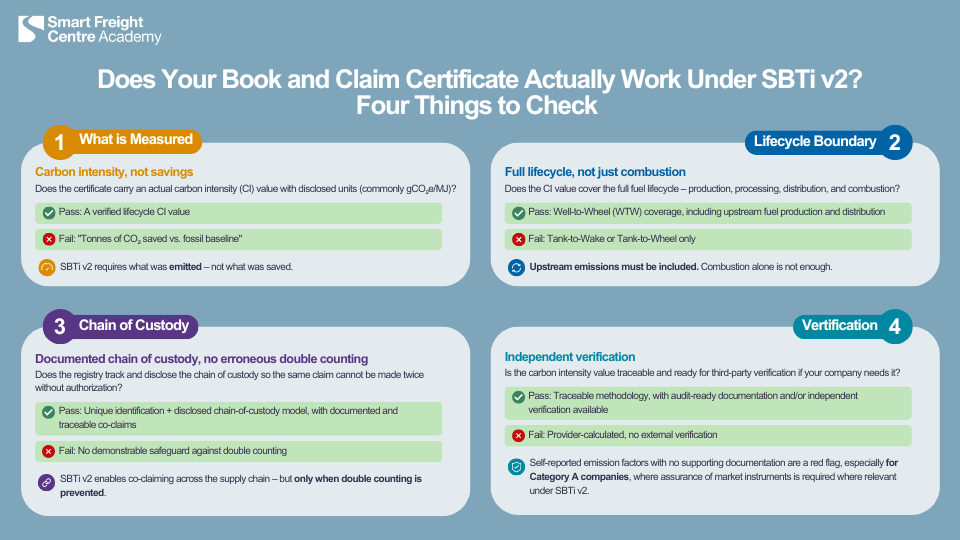
Download below to see the full infographic.
In our previous article on "SBTi Corporate Net Zero Standard v2: What It Requires and Why Attributional Accounting Is the Foundation", we established that SBTi's Corporate Net Zero Standard v2 requires attributional accounting as the basis for GHG inventory reporting and target achievement. That requirement has direct consequences for how Book and Claim certificates are structured.
But what does that mean in practice? If you are currently using – or evaluating – a Book and Claim system, how do you know whether it actually meets the standard? These four checks give you a starting point.
Check 1: Does the certificate carry an actual carbon intensity value?
What to look for: A certificate should express its emissions value as a verified lifecycle carbon intensity with clearly disclosed units – commonly expressed in gCO₂e per megajoule (gCO₂e/MJ).This is an attributional value. It reflects what was actually emitted across the fuel's full lifecycle.
What to watch out for: If a certificate expresses its value as "tonnes of CO₂ saved compared to a fossil fuel baseline," that is a consequential number. It describes a difference between two scenarios, not an actual emission. Under SBTi v2, it cannot be used to satisfy a target in your GHG inventory.
The simple test: Does the certificate tell you what was emitted, or what was saved? SBTi v2 requires the former.
Check 2: Does the carbon intensity value cover the full fuel lifecycle?
What to look for: SBTi v2 requires transportation emissions to be reported on a well-to-wheel or well-to-wake (WTW) basis – the two terms describe the same full lifecycle boundary, with "wake" sometimes used for aviation and "wheel" for road and other surface modes. Either way, emissions from fuel production, processing, and distribution must be included, not just the combustion step.
What to watch out for: Some certificates account only for tank-to-wheel or tank-to-wake emissions – combustion only. This understates the actual carbon intensity of the fuel and does not satisfy the full lifecycle requirement.
The simple test: Ask your provider: does the carbon intensity value in this certificate include upstream production and distribution emissions? If the answer is no, or unclear, the certificate does not cover the full scope SBTi v2 requires.
Check 3: Does the registry prevent erroneous double counting of the same value?
What to look for: SBTi v2 explicitly enables co-claiming – a shipper and a carrier can legitimately reference the same lower-emission activity at different points in the supply chain, provided this is transparently documented and the outcomes are not over-attributed. What the registry behind a Book and Claim certificate must demonstrate is unique identification and tracking of each profile, with the specific chain-of-custody model disclosed (for example, direct claim, indirect claim, or claim and rebook), so that any double counting is intentional, disclosed co-claiming rather than an undocumented error.
What to watch out for: Not all registries are designed with this level of traceability. If a platform cannot demonstrate how it tracks, books, and claims a profile, or which chain-of-custody model applies, there is an erroneous double counting risk – and that risk undermines the integrity of any target reporting built on those certificates.
The simple test: Ask your registry or platform provider: how does the system uniquely identify and track each profile, and which chain-of-custody model applies? If more than one party can claim the same profile, is that documented, intentional co-claiming, or an undisclosed gap?
Check 4: Is the carbon intensity value traceable and verifiable?
What to look for: The carbon intensity value on a certificate should be traceable to a documented source and methodology – an independently audited lifecycle assessment or a certified methodology is the strongest evidence. Under SBTi v2, Category A companies are required to obtain independent third-party assurance of the market instruments used to support target implementation, where relevant, so the underlying data needs to be ready to support that process even if it has not yet been verified.
What to watch out for: Self-reported or provider-calculated emission factors with no documented methodology or supporting evidence are a weak basis for reporting. If your company is Category A and uses the certificate to support target implementation, you will need independent third-party assurance of the market instrument; a provider that cannot produce auditable documentation puts that assurance at risk.
The simple test: Ask your provider: what standard or methodology was used to calculate the carbon intensity value, and is documentation available to support independent verification if your company needs it? If the answer is "we calculated it internally and have no supporting records," that is a gap worth addressing before you rely on the certificate.
What to do if your setup does not pass?
Not all existing platforms will meet these checks. That does not mean Book and Claim is off the table – it means the market is still catching up to what SBTi v2 now requires.
The starting point is to ask these questions of your current or prospective providers directly. The answers will tell you quickly whether a platform is built on attributional principles or whether it relies on consequential logic that will not count toward your targets.
SFC's Market-Based Measures Framework was designed around attributional accounting, multimodal coverage, and the registry safeguards needed for legitimate co-claiming – built for exactly what SBTi v2 requires.
Download the infographic (PDF) for a full overview of the four practical checks to apply to any Book and Claim certificate or program.
Download the infographic (PDF) for a full overview of the four practical checks to apply to any Book and Claim certificate or program.
Want to understand the accounting principles behind these checks in more depth? Explore SFC Academy courses below.
Courses related to this subject:
Who we are
The Smart Freight Centre Academy is the education and knowledge-hub of globally recognised NGO Smart Freight Centre, a leader in freight decarbonization practices, standards and frameworks.
Copyright © 2026
10% Discount
Start Your Freight Decarbonization Learning Journey.
Receive 10% off your first course.
Coupon Code:
SFCAcademy10
SFCAcademy10
Are you an SFC member? Go to our resource centre to explore your member benefits.