
Clean Air Action: The Emergency Brake on Climate Change
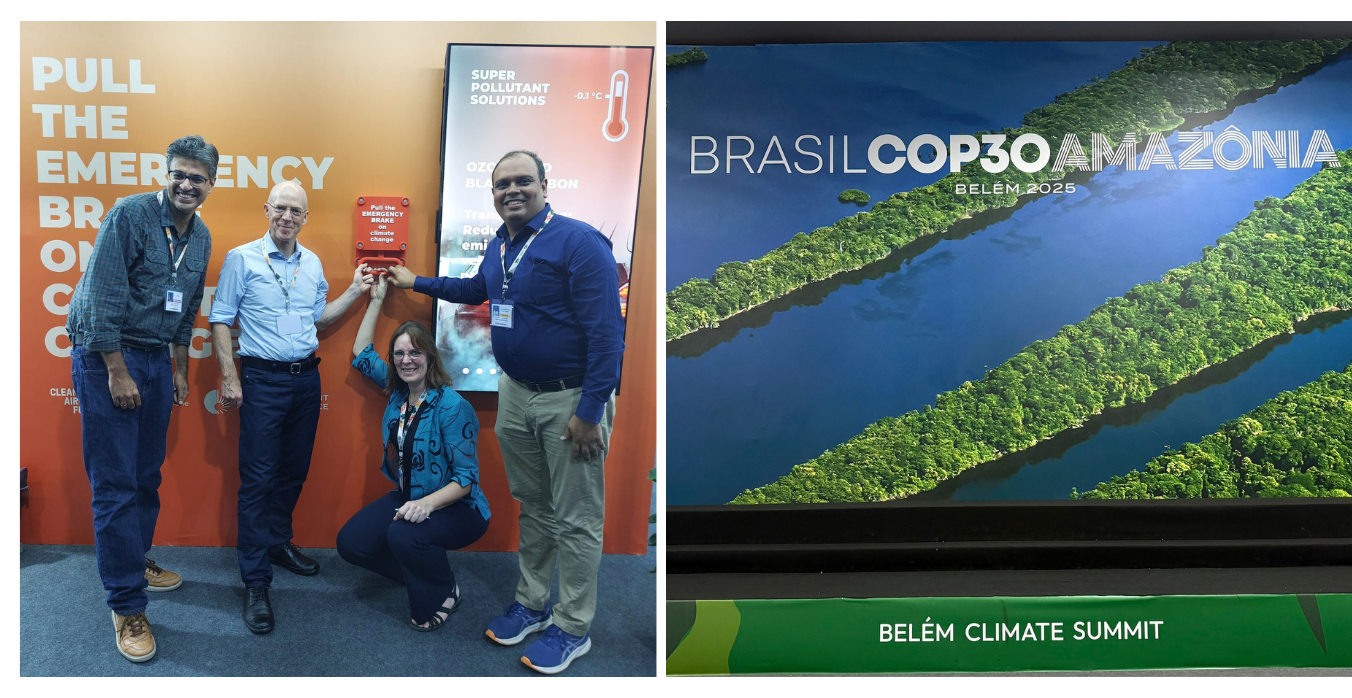
The Alliance for Clean Air was launched at COP26 in Glasgow by the World Economic Forum, the Clean Air Fund and Stockholm Environment Institute to unite business leaders in championing air pollution measurement and action, and to bring air quality squarely into the climate movement.
The Funder: Sean Maguire, Executive Director, Clean Air Fund
The NGO: Pawan Mulukutla, Executive Director, Integrated Transport, Clean Air & Hydrogen
Four years later, at COP30, a funder (Clean Air Fund), a founding company (IKEA), and an active NGO (the World Resources Institute), came together to reflect on progress and explore what else is needed. Sophie Punte, Founder of Smart Freight Centre, which is the newest member of the Alliance, was curious to find out what role better measurement of emissions from freight transport and logistics can play.
The Funder: Sean Maguire, Executive Director, Clean Air Fund
Is air pollution on the agenda as you envisaged when the Alliance was launched?
We know that with collective action, we can solve global challenges, just like we did with international agreements on acid rain and the ozone layer. We have not yet seen the same concerted effort to reach the WHO target of halving the number of deaths from air pollution by 2040. 2024. The good news is that air pollution remains firmly on the political agenda, as seen by the Cape Town Ministerial Declaration on Air Quality issued ahead of the G20 summit right after COP30.
Can you give us a quick overview of air pollution guidelines and tools?
To act on the call for cleaner air, companies need clear information, guidance and tools. The Stockholm Environment Institute, the Climate and Clean Air Coalition (CCAC) and IKEA issued air pollutant assessment guidelines for companies in 2022. This year, they released integrated guidelines that cover ‘everything’: greenhouse gases, short-lived climate pollutants, traditional air pollutants and heavy metals across the corporate value chains. The Global Reporting Initiative also issued GRI 305 standards in 2016 covering GHG and air pollutants, with an update planned for 2026.
In parallel, Smart Freight Centre developed the GLEC Framework to help companies calculate and report GHG emissions from freight transport and logistics. Transport, especially heavy freight trucks and ships, contributes 23% of Black Carbon (BC) or soot. That is why in 2017 SFC and CCAC released a ‘sister’ module for BC from logistics, and this year this was expanded to include four key air pollutants: NOx, SOx, Particulate Matter (PM) and BC. While each guideline has a slightly different focus, the important thing is that they are aligned and consistent.
Do you see a role for air quality in the climate agenda going forward?
We cannot ignore the geopolitical tensions and backlash against climate action, which has seen some corporate actors run for shelter. The guidelines and collaboration we foster through the Alliance for Clean Air allow us to take practical, ground-level steps focused on local air pollution that also support climate goals. Weak or inconsistent data on air pollution still leads to patchy and uncoordinated policy responses. That is why the Clean Air Fund supports bottom-up action by empowering communities to monitor the pollution that makes them sick themselves! Examples are runners in Africa, school children in Poland, and young mothers in the UK. We must be patient and persistent in this long-term effort, but we will bend the air pollution curve toward clean air!
The Company: Sriram Rajagopal, Head of Climate and Air Quality, IKEA
As one of the founding members of the Alliance for Clean Air, why is action on air pollution important to you?
IKEA’s vision is “to create a better everyday life for the many people”. Air pollution directly affects people’s health and well-being and is therefore both a moral duty and a business imperative. Because much of our transport is subcontracted, we integrated air quality management into our IWAY supplier code of conduct. This allows us to work closely with our suppliers on concrete improvement measures.
How do these guidelines help you?
We used the 2022 guidelines to develop pollutant inventories for 2023, 2024 and now 2025 across five pollutants, including Black Carbon. While the guidelines support regulatory compliance, the real value is strategic planning, as they help us to prioritize and sequence our transition actions. For example, we prioritized electrification of urban logistics and deliveries and expanded intermodal transport using trains and barges.
It also helped us to avoid financial lock-in. For example, we paused in biomass installations in South Asia due to air pollution concerns, choosing instead to accelerating electrification. In practice, we evaluate greenhouse gas emissions and air pollution in tandem.
Can you share an example of how IKEA is helping reduce air pollution?
We aim not only to measure pollutants but also to be part of the solution. Let me give you an example for India, where 95% of the population breathes polluted air. Crop burning contributes heavily to Black Carbon emissions that affect people’s health but also lands on the snow in the Himalayas and accelerate melting. In the past, we have collected post-harvest rice straw that is normally burned and turned it into IKEA products like baskets, bowls and rugs! Can you imagine if this idea is picked up in other regions with seasonal air pollution from crop burning. We help solve the local air pollution problem into an economic opportunity for communities with locally made products!
Are other companies following your lead?
Many corporations still see air pollution as ‘one more thing’ on their plate, and some might lack technical competencies. That is why clear guidelines and tools are so helpful in showing companies that GHGs and air pollutants can be monitored together. Regulatory developments such as the EU Corporate Sustainability Disclosure Directive (CSRD) and stronger integration of clean air into national climate plans (NDCs) will help advance action.
My advice to companies: measure air pollution and its impacts, prioritize proven solutions such as electric vehicles and charging infrastructure as well as intermodal transport, and ensure a just transition by involving local communities, employees and suppliers.
The NGO: Pawan Mulukutla, Executive Director, Integrated Transport, Clean Air & Hydrogen
Do you see action on air pollution happening or are there gaps?
Thirteen of the world’s 20 most polluted cities are in India, with winter conditions trapping pollution between October and February. We understand the problem but there are gaps in identifying pollution sources, transport being a major one. Another challenge is that costs and benefits of solutions are unevenly distributed. Wealthier people can shield themselves with air purifiers and travel in air-conditioned cars, while most people cannot. Finally, real progress only happens when multiple stakeholders coordinate and then the public is directly involved, because local communities feel the immediate benefits.
How is WRI contributing?
India’s urban air quality crisis needs solutions that are targeted, data-driven, and locally relevant. That’s where our Accelerator for Clean Air Actions (ACAAS), comes in. Through this initiative, WRI India is working with 10 cities—Mumbai, Pune, Surat, Vadodara, Ahmedabad, Chennai, Gurugram, Indore, Agra, and Gorakhpur—to strengthen their institutional capacity and turn clean air plans into real-world results.
We’re helping cities prepare practical solutions, build consensus among stakeholders, and drive long-term policy changes. This includes sector-specific actions like promoting clean construction practices, eliminating open waste burning, transitioning bakeries to cleaner fuels, deploying effective road dust mitigation techniques, and introducing Low Emission Zones to cut vehicular pollution.
One example is the construction sector, which is a major contributor to particulate matter emissions in India. When emissions from construction activities go unchecked, fine particles are released into the air, settle on surfaces, and then get re-suspended by wind, vehicles, or even human movement. To tackle this, we launched the India Alliance for Clean Construction (IACC) under ACAAS. The goal is to bring all stakeholders together and work toward a clean construction transition. Recently, we conducted pilots at some of the construction sites to understand how effective different mitigation measures are during various stages of construction. To monitor the impact, we deployed low-cost sensors, which gave us valuable insights into what works best on the ground.
In addition to construction, we’ve also supported partner cities in reducing emissions from open waste burning. We carried out field surveys and published a study on open waste burning and mitigation strategies. This study helped cities implement a pilot program where we saw a significant reduction in emissions. That success was achieved through a combination of capacity building, stakeholder engagement, and infrastructure improvements.
We are addressing these gaps through our Clean Air Catalyst initiative in three cities: Jakarta in Indonesia, Indore in India, and Nairobi in Kenya. In Indore, we installed monitoring stations near schools and government offices and use source-apportionment techniques to show that transport and construction dust were the largest contributes to Black Carbon, primarily from trucks. This evidence supports practical solutions such as phasing out older trucks and deploying electric freight vehicles. Getting this implemented works better through partnerships between civil society and private sector players. Stories on India’s recent collaborative efforts to advance electric freight mobility are captured in the e-Fast Handbook.
Does better data strengthen the business case?
Acting on air pollution and climate change together creates a much stronger business case: economic development, job creation, health benefits. It also advances equity for women, children, the elderly and low-income communities who are disproportionately affected. Better data absolutely strengthens the case, especially when communities and companies collect it themselves to build a bottom-up air and climate pollutant inventories. Digital technologies have opened new opportunities for air quality monitoring and management.
Addressing air pollution, including from freight transport and logistics, is an undervalued opportunity and can really boost climate action. Clean air action is the emergency brake on climate change!
Courses related to this subject:
Who we are
The Smart Freight Centre Academy is the education and knowledge-hub of globally recognised NGO Smart Freight Centre, a leader in freight decarbonization practices, standards and frameworks.
Copyright © 2026
10% Discount
Start Your Freight Decarbonization Learning Journey.
Receive 10% off your first course.
Coupon Code:
SFCAcademy10
SFCAcademy10
Are you an SFC member? Go to our resource centre to explore your member benefits.