
How CountEmissionsEU Will Change Transport Reporting
The New Regulatory Landscape
For years, logistics GHG accounting has been fragmented, not because methodologies were missing, but because they have been applied inconsistently. Without a clear EU-wide requirement, companies have used different standards, emission factors, and assumptions, making results hard to compare and increasing the risk of confusion or greenwashing.
This changed on April 29, 2026, with the adoption of Regulation (EU) 2026/1030, known as CountEmissionsEU. The regulation entered into force on June 1, 2026, with full compliance expected by end of 2030. It is the first EU-wide regulated methodology for calculating transport-related greenhouse gas (GHG) emissions.
1. Is Calculation Mandatory?
Calculating transport emissions remains voluntary for most operators. However, if you choose to share or publish GHG emission figures for commercial, marketing, or contractual purposes, you must use the official EU methodology. In short: if you say your service is low-carbon, you need to be able to prove it using this standard.
2. The Single Common Language: ISO 14083
To ensure consistency in accounting and reporting GHG emissions, the EU has adopted EN ISO 14083:2023 as the standard approach. Two key principles underpin this:
-
Well-to-Wheel (WTW): You must account for the full lifecycle of the energy used from extraction and production (Well-to-Tank) to actual vehicle use (Tank-to-Wheel).
-
Operational Focus: The current focus is on vehicle use and energy provision during operations. The European Commission will assess expanding this to full vehicle life-cycle (manufacturing and disposal) within four years.
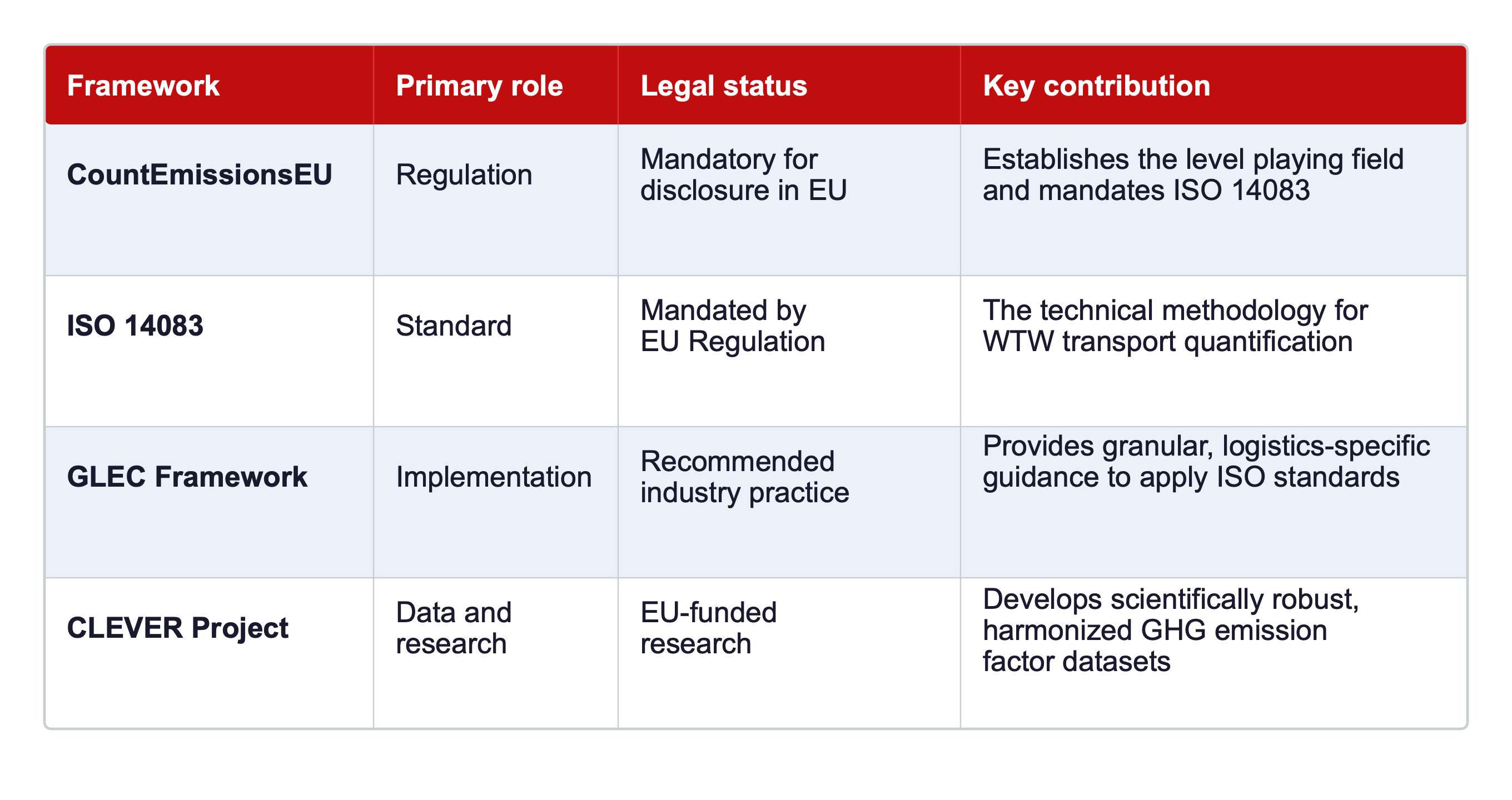
Comparison of Key Frameworks
The table below shows how CountEmissionsEU, ISO 14083, the GLEC Framework, and the CLEVER Project relate to each other.
Implementation and Data Quality
Moving from theory to practice requires the right tools and data. This is where the GLEC Framework and the CLEVER Project become essential for your operations.
1. The GLEC Framework: Your Roadmap
The GLEC Framework is the industry’s most advanced guide for implementing ISO 14083. It helps you:
-
Divide the Transport Chain: Use a bottom-up approach by breaking your operations into Transport Chain Elements (TCEs)—single vehicles or hubs.
-
Categorize Operations: Use Transport/Hub Operation Categories (TOCs/HOCs) to group similar trips and identify emission intensities.
-
Track Efficiency: Use metrics of emission intensity values (gCO2e/tkm) to benchmark performance.
The GLEC Framework contains the necessary data, calculation steps and reporting details for you to adhere to ISO 14083, and thus the CountEmissionsEU regulation.
2. The CLEVER Project: Methodology and Database
Smart Freight Centre has been working alongside academia and industry to develop harmonized and scientifically robust GHG emission factors for the transport sector, covering both conventional and emerging fuels across their full Well-to-Wheel (or Well-to-Wake) lifecycle. In addition to producing validated emission factors, the project establishes a common framework and guidance for consistent GHG emissions calculation, accounting, and integration into databases and reporting systems, supporting reliable and comparable GHG assessments across transport modes and alignment with evolving European standards.
3. Summary for Transport Operators
-
Prioritize Primary Data: The EU rules favor actual fuel and energy measurements over industry defaults to ensure accuracy.
-
Prepare for Verification: Disclosure of data may require third-party verification to obtain a "proof of compliance" recognized across the European Union.
-
Leverage Procurement: Accurate GHG data is increasingly a requirement in tenders. Using these frameworks allows you to turn sustainability into a competitive advantage.
Getting Started
Disclose transport emissions in the EU? ISO 14083 is the new standard for transport emissions. The GLEC Framework, developed by Smart Freight Centre, makes the standard practical and your data tender-ready. Join the SFC community for the guidance, tools, and recognition that turn compliance into competitive edge.
Do you have any questions, or want to learn more about this topic? Reach out to Mehul Khandelwal, Technical Manager MS&A.
Enroll in the courses below to learn more about this topic.
Courses related to this subject:
Who we are
The Smart Freight Centre Academy is the education and knowledge-hub of globally recognised NGO Smart Freight Centre, a leader in freight decarbonization practices, standards and frameworks.
Copyright © 2026
10% Discount
Start Your Freight Decarbonization Learning Journey.
Receive 10% off your first course.
Coupon Code:
SFCAcademy10
SFCAcademy10
Are you an SFC member? Go to our resource centre to explore your member benefits.