
Decarbonizing Logistics: From Optimization to Zero-Emission Freight – What Companies and Investors Need to Understand

Three Core Solution Levers for Reducing Logistics Emissions
Optimization of the Logistics Network
Adoption of Alternative Fuels and Zero-Emission Technologies
Optimization focuses on improving how existing transport systems operate. Examples highlighted in the Concept Note include redesigning supply networks so that production sites and warehouses are closer to customers and suppliers, optimizing routing to reduce total distance travelled, reducing empty trips and increasing load factors and vehicle capacity utilization
These measures reduce fuel use and therefore reduce greenhouse gas emissions. Because they improve efficiency within current systems, optimization is described as the most mature and widely implemented solution lever.
Modal Shift
Modal shift refers to reorganizing freight flows so that goods move via transport modes with lower emissions per tonne-kilometer.
Examples include shifting freight from road to rail and shifting freight from road to inland waterways.
Different transport modes have different emission intensities. When operationally feasible, shifting freight to lower-emission modes can reduce overall logistics emissions. This lever is considered a growing practice that requires coordination and supporting infrastructure.
Adoption of Alternative Fuels and Zero-Emission Technologies
The third lever involves transitioning away from conventional fossil fuels toward lower-emission or zero-emission energy carriers.
The Concept Note refers to: drop-in fuels such as biofuels and new energy carriers requiring different drivetrains, including electricity and hydrogen.
Within road freight, battery-electric trucks are highlighted as a primary alternative fuel solution for road freight while biofuels are described as a potential transitional option.
This lever is considered less mature than optimization and modal shift and is categorized as emerging practice. It is because it depends on factors beyond operational control, including availability of vehicle technology, development of charging or fueling infrastructure, upfront investment requirements, and coordination across multiple stakeholders
As a result, large-scale deployment is still developing compared to optimization and modal shift.
Understanding Solution Maturity
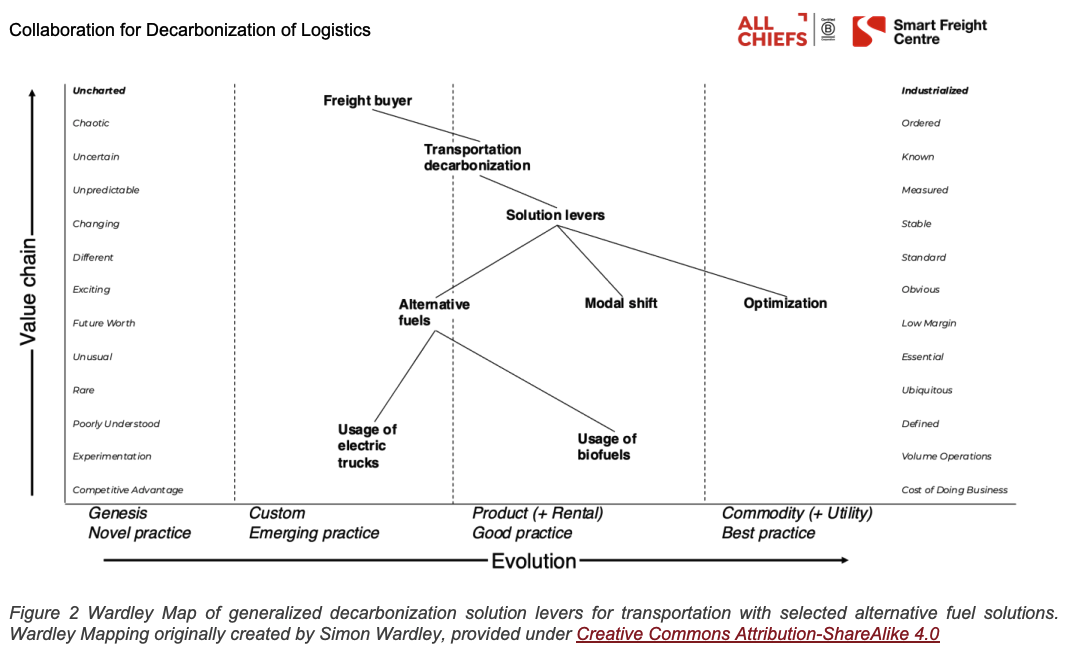
Not all decarbonization solutions develop at the same pace, and this directly affects how they can be implemented and scaled. The Concept Note illustrates this using a Wardley Map (Figure 2), which positions the different solution levers along an evolution spectrum – from emerging and experimental practices to standardized and widely adopted approaches.
This progression highlights that each lever requires a different approach. More mature solutions, such as optimization, can typically be scaled through operational improvements and procurement decisions. In contrast, less mature solutions, particularly alternative fuels and zero-emission technologies, depend on technological development, infrastructure build-out, and longer investment cycles.
Understanding this maturity spectrum helps companies and investors determine where immediate emissions reductions are possible while also preparing for larger structural shifts over time.
The Role of Collaboration
The Factbook supports investors and decision-makers by providing data on market developments, technology pathways, and regional adoption of zero-emission commercial vehicles. This makes it a useful complement to the Concept Note, as it illustrates how emerging solutions are evolving in practice.
Recent data show strong year-on-year growth in global sales of zero-emission medium- and heavy-duty trucks, indicating that these technologies are moving beyond early-stage pilots and entering broader market deployment. The Factbook also highlights that China accounts for a large share of global sales, while Europe is experiencing continued growth in adoption.
Battery-electric trucks currently represent the majority of zero-emission commercial vehicle sales, reflecting their position as the leading technology pathway in road freight. At the same time, continued improvements in vehicle technology, combined with policy support, are contributing to increased deployment across regions.
Overall, these trends reinforce that while zero-emission technologies are still developing, they are becoming an increasingly viable pathway within the broader decarbonization framework.
What Companies and Investors Should Understand
Taken together, the two publications demonstrate that logistics decarbonization is not dependent on a single solution, but rather a progression of complementary pathways.
Emission reductions can be approached through three defined solution levers – optimization, modal shift, and alternative fuels. These levers differ in maturity, with optimization being the most established and zero-emission technologies still scaling.
Collaboration plays a central role in enabling practical implementation across logistics value chains, particularly as emerging solutions require broader coordination and investment to scale effectively. Zero-emission truck markets are expanding, with battery-electric technology currently leading deployment.
Ultimately, understanding both the structural solution framework and the market data helps companies design practical decarbonization strategies and enables investors to interpret how zero-emission freight is evolving.