
Port Pair vs. Trade Lane Aggregation: What’s the Difference?
As emissions reporting in logistics continues to evolve, the way data is aggregated is becoming increasingly important. For years, trade lane aggregation has been the standard approach for understanding emissions across shipping corridors. However, with growing demand for more accurate and transparent reporting, port-pair aggregation is emerging as the new reference point.
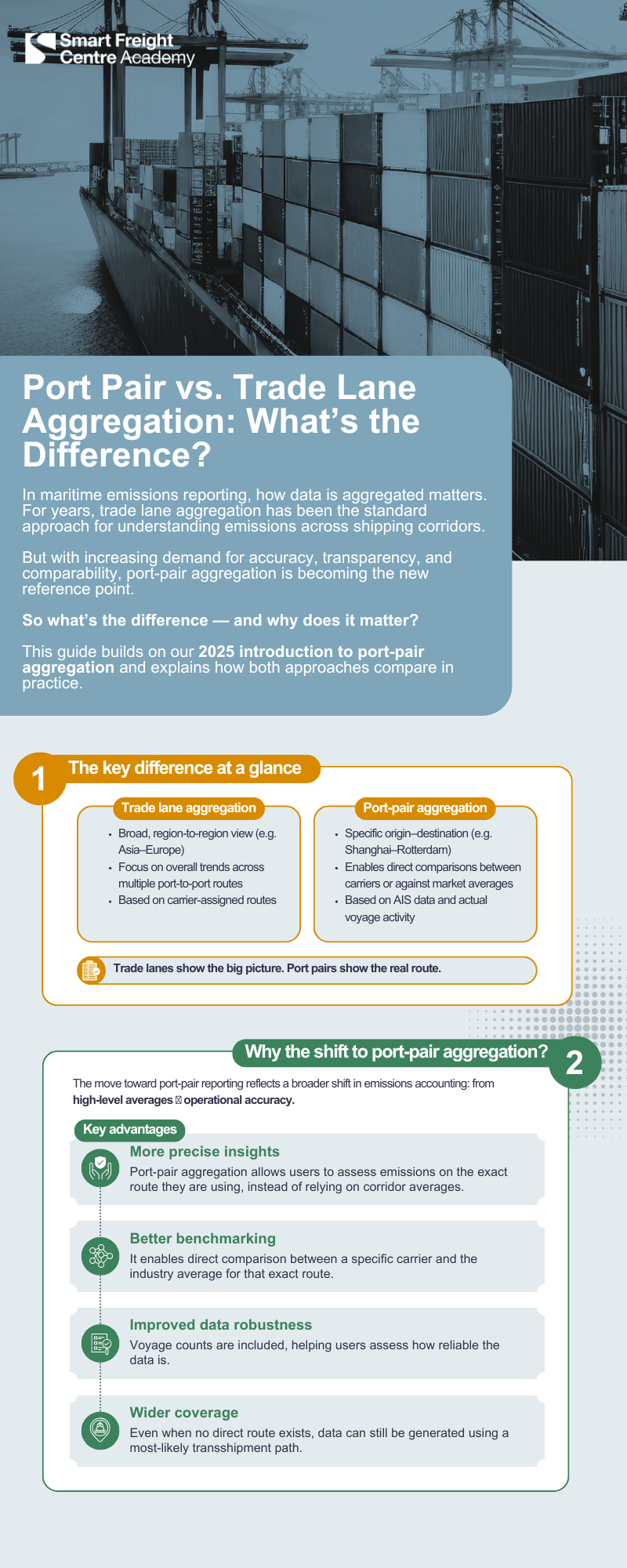
Trade lane aggregation provides a broad view of shipping activity by grouping routes into larger regional corridors, such as Asia–Europe. While this approach is useful for identifying overall trends and understanding industry-wide performance, it relies on carrier-assigned routes and averages across multiple port combinations.
Port-pair aggregation takes a more detailed approach. Instead of grouping multiple routes together, it focuses on specific origin and destination combinations, such as Shanghai–Rotterdam, using AIS data and actual voyage activity. This allows for a more accurate view of emissions on the route being used.
Why is the industry shifting toward port-pair aggregation?
Several factors are driving this change:
-
More precise insights: emissions can be assessed for specific routes rather than relying on corridor averages.
-
Better benchmarking:users can compare carrier performance directly against market averages on the same route.
-
Improved data robustness: voyage counts help assess the reliability of the data.
-
Wider coverage: when no direct route exists, a likely transshipment route can still be generated.
Port-pair methodologies also make it possible to determine the most likely route when direct connections between ports do not exist. The process involves cleaning data, identifying eligible hubs with sufficient activity, and selecting the most realistic route based on factors such as sailing frequency and travel distance balance.
What does this mean going forward?
What does this mean going forward?
The transition to port-pair reporting is more than a technical update — it reflects a broader shift toward operational accuracy and decision-useful emissions data.
As reporting practices continue to mature:
-
Port-pair aggregation is expected to become the primary reporting format
-
Users will increasingly work with carrier-specific data and industry benchmarks
-
Greater transparency and stronger alignment with emissions accounting standards will become increasingly important
Trade lanes still serve an important purpose for high-level analysis. But for organizations looking to make more informed procurement decisions and improve emissions reporting accuracy, port-pair aggregation provides a more granular and practical view.
Download the full infographic (PDF) to learn more.
Download the full infographic (PDF) to learn more.
This infographic is a follow-up to our previous article on port-pair aggregation, offering a practical comparison between port-pair and trade lane reporting and explaining why this shift matters for logistics emissions reporting.
This infographic is a follow-up to our previous infographic on port-pair aggregation, offering a practical comparison between port-pair and trade lane reporting and explaining why this shift matters for logistics emissions reporting. Read more here.
Want to better understand how to apply this in your reporting or decision-making?
Explore our courses below.
Courses related to this subject:
Who we are
The Smart Freight Centre Academy is the education and knowledge-hub of globally recognised NGO Smart Freight Centre, a leader in freight decarbonization practices, standards and frameworks.
Copyright © 2026
10% Discount
Start Your Freight Decarbonization Learning Journey.
Receive 10% off your first course.
Coupon Code:
SFCAcademy10
SFCAcademy10
Are you an SFC member? Go to our resource centre to explore your member benefits.