
Why EV Pilots Disappoint – And the 4-Stage Roadmap to Scaling Electric Trucks in Logistics

As logistics companies increasingly pursue electric vehicle (EV) deployment to decarbonize road freight, many organizations are discovering that launching pilot projects is only the beginning.
According to Smart Freight Centre and Maersk’s Electric Vehicle Deployment Playbook Guidelines were specifically developed to help fleet owners move beyond what the report describes as the “pilot trap” (p. 5)–a common industry challenge where companies successfully test EVs in small-scale pilots but struggle to transition toward broader operational deployment.
This report stands as the first comprehensive EV deployment guideline specifically designed to provide a pragmatic framework not just for testing the waters, but for scaling electric freight solutions.
Understanding the pilot trap
According to the guidelines (pp. 6–15), many fleet operators face recurring challenges that prevent successful scaling:
-
Limited charging infrastructure readiness
-
Insufficient route and operational suitability analysis
-
Misalignment between sustainability, procurement, and operations teams
-
Financial complexity and total cost of ownership uncertainty
-
Difficulty integrating pilot-stage learnings into broader deployment strategies
Without addressing these structural barriers, EV deployment can remain confined to experimentation rather than progressing toward meaningful logistics transformation.
EV deployment is more than fleet replacement
A core message throughout the guidelines is that electrification is not simply about purchasing electric trucks.
Instead, successful EV deployment requires a broader business transformation process involving:
-
Strategic planning
-
Operational redesign
-
Infrastructure development
-
Internal coordination
-
Long-term scaling readiness
This shift from isolated pilots to enterprise-wide deployment is what allows organizations to escape the pilot trap.
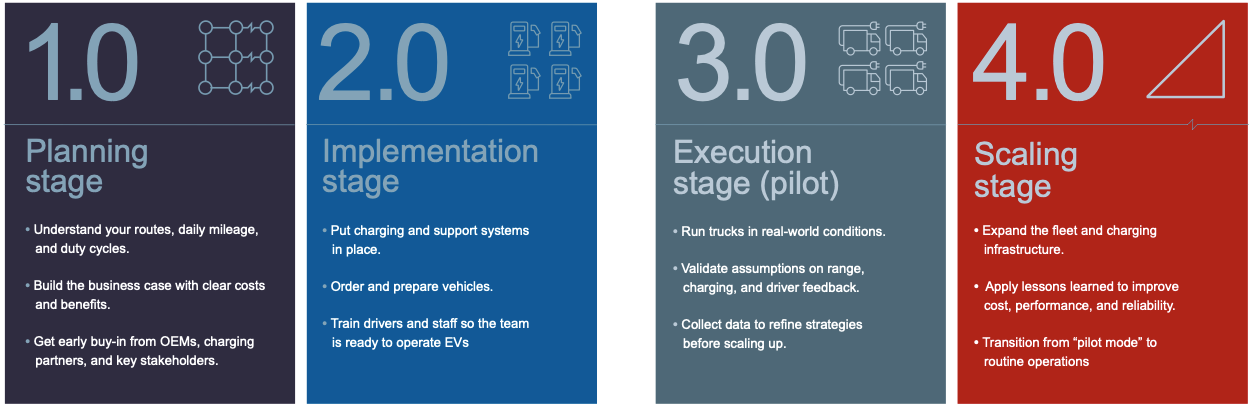
The 4-stage roadmap to scaling electric trucks
To enable organizations to move beyond pilots, the guidelines outline a structured four-stage deployment framework (pp. 19–27):
Planning Stage
Establish the foundation by analyzing routes, mileage, and duty cycles, building the business case, and securing early stakeholder and partner alignment.
Implementation Stage
Prepare for deployment by installing charging infrastructure, procuring vehicles, and training operational teams to support EV integration.
Execution Stage (Pilot)
Test EVs in real-world operations, validate performance assumptions, and gather operational data to refine deployment strategies.
Scaling Stage
Expand fleet deployment and infrastructure, apply pilot learnings to improve performance and cost-efficiency, and transition from pilot projects to routine large-scale operations.
Key takeaway
The guidelines clearly position EV deployment as a long-term operational transformation rather than a short-term pilot initiative.
Fleet owners that successfully decarbonize road freight will be those that use pilot programs strategically, while simultaneously preparing the systems, infrastructure, and organizational capabilities required for scaling.
Final thought
For logistics companies serious about fleet electrification, avoiding the pilot trap is essential.
Smart Freight Centre and Maersk’s guidelines provide a practical roadmap for moving from experimentation to scalable deployment – helping organizations build the foundations for meaningful zero-emission freight transformation.
For the full framework, deployment tools, and detailed implementation guidance, read the complete Electric Vehicle Deployment Playbook Guidelines.
To learn more about this topic, enroll in our courses below.
To learn more about this topic, enroll in our courses below.
Courses related to this subject:
Who we are
The Smart Freight Centre Academy is the education and knowledge-hub of globally recognised NGO Smart Freight Centre, a leader in freight decarbonization practices, standards and frameworks.
Copyright © 2026
10% Discount
Start Your Freight Decarbonization Learning Journey.
Receive 10% off your first course.
Coupon Code:
SFCAcademy10
SFCAcademy10
Are you an SFC member? Go to our resource centre to explore your member benefits.