
Zero-Emission Trucks are Here:
Ecosystem Readiness Determines Where They Scale
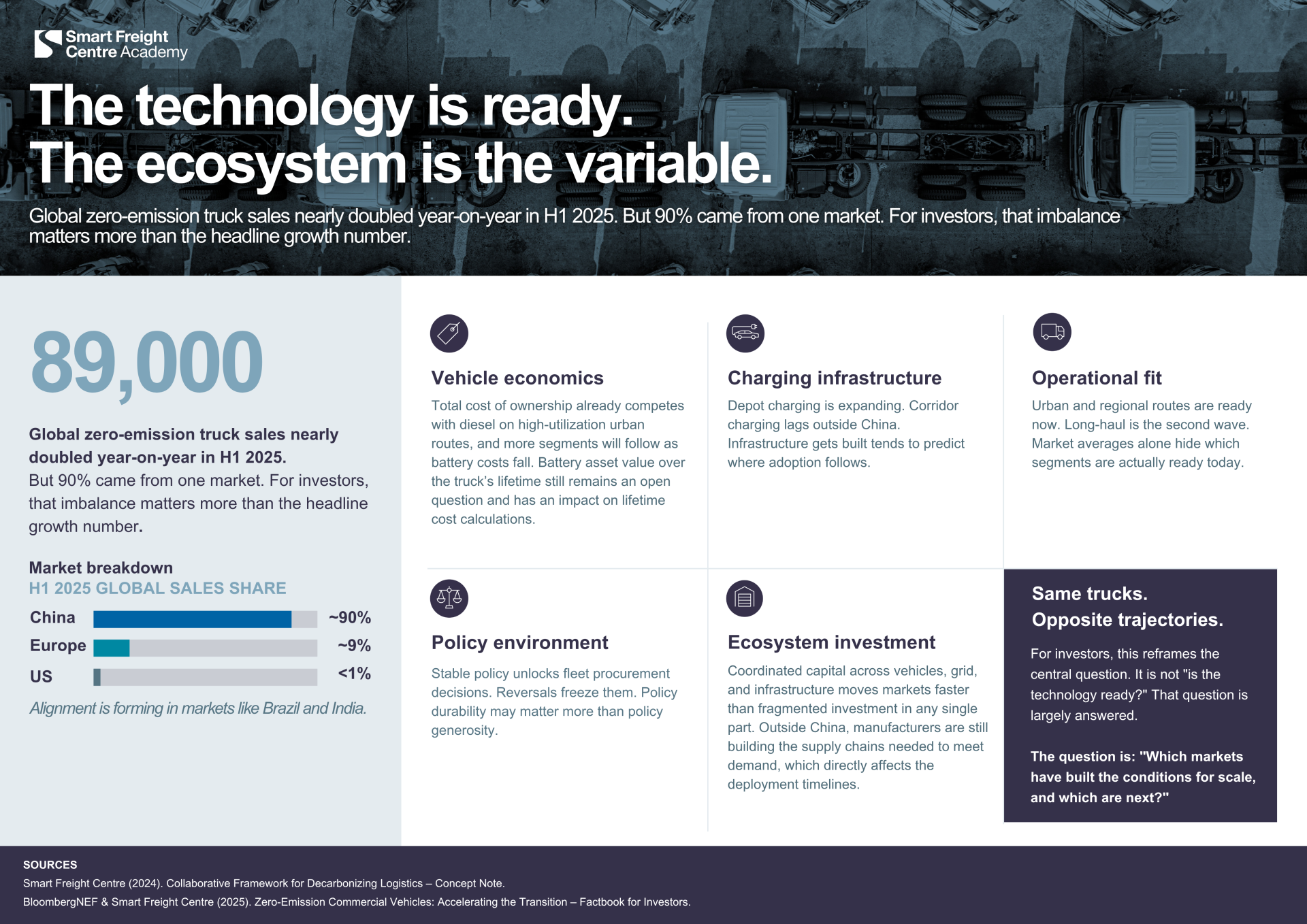
Download below to see the full infographic.
In the first half of 2025, nearly 90,000 zero-emission trucks were sold globally – almost as many as in all of 2024. The transition to zero-emission freight is no longer a forecast. It is happening.
But here is what the headline number obscures: over 90% of those sales came from a single market: China. Europe is growing steadily. The US market has effectively stalled, with only 200 units sold in the first half of the year.
The technology is largely the same across all three. What is different is the ecosystem around it.
This is the essential insight from the Zero-Emission Commercial Vehicles Factbook for Investors (BloombergNEF & Smart Freight Centre, 2025): technology risk in zero-emission freight is largely resolved. What remains is ecosystem risk and that varies dramatically by market.
The divergence is a policy story
The contrast between markets is not a technology story. Battery-electric trucks now make up 97% of global zero-emission truck sales. The hardware exists, the manufacturing capacity is scaling, and the economics are already competitive in high-utilization use cases.
What separates China and Europe from the US is the policy environment surrounding that technology.
In Europe, CO₂ emissions targets for trucks came into force in 2025. In the Netherlands, municipalities are now permitted to designate urban zero-emission zones – a measure that has pushed electric commercial van sales above 80% of total new registrations nationally. In the US, the reversal of incentives and regulatory uncertainty under the current administration has pushed sales close to zero.
Same trucks. Opposite trajectories.
For investors, this reframes the central question. It is not "is the technology ready?" That question is largely answered. The question is: "Which markets have built the conditions for scale, and which are next?"
Five factors that determine whether a market scales
The Factbook points to five interconnected factors that determine deployment speed in any given market. Understanding these as a system, not a checklist, is where the investor analysis begins.
Vehicle economics
Zero-emission trucks carry higher upfront costs than diesel today. But total cost of ownership (TCO) is already competitive in specific segments: urban delivery, port operations, fixed routes, and other high-utilization applications where lower fuel and maintenance costs offset the purchase price over time.
Battery costs continue to fall. As they do, TCO parity will expand to more segments and more geographies. The relevant investor question is not whether parity arrives – it is which segments and markets reach it first, and what the adoption curve looks like when they do.
At the same time, while the total cost of ownership of battery-powered commercial vehicles is declining, manufacturers, fleet owners and fuel providers face uncertainties in determining the precise TCO in various duty cycles. Battery asset value over the truck’s lifetime still remains an open question.
Most market participants currently assume very low residual value for electric truck batteries once they reach end of life in a vehicle. In practice, those batteries still retain 70–80% of their original capacity and can generate value as stationary storage assets or through material recycling. The gap between assumed and actual residual value has a large impact on economics.
Charging infrastructure
Deployment depends on where trucks can charge. Depot charging at logistics hubs is expanding across leading markets. Corridor charging for long-haul operations remains limited outside China.
Infrastructure availability directly determines which freight applications can electrify now, and which must wait for the network to catch up. Markets investing in charging today are building the structural preconditions for accelerated adoption tomorrow. Investors should treat infrastructure buildout as a leading indicator, not a lagging consequence
Operational fit
Battery range, payload capacity, and charging time determine which applications are viable at current technology levels. Urban and regional operations are well-served by today's vehicles. Long-haul is following, but more slowly.
The practical implication: deployment is not uniform across freight segments, even within a single market. Investors should map which segments within a target market are already operationally ready. These represent the nearer-term opportunity; longer-haul and heavier applications represent the second wave.
Policy environment
As the market divergence makes clear, policy is not a soft contextual factor. It is the variable most directly connected to near-term market size.
Stable, forward-looking policy – emissions targets, zero-emission zone frameworks, purchase incentives, infrastructure investment mandates – creates the conditions in which fleet operators can make multi-year transition commitments. Policy instability does the opposite: it freezes procurement decisions and delays infrastructure investment, regardless of where the technology stands.
In evaluating any market, investors should assess not just current policy but policy durability. A strong incentive program with uncertain longevity may be worth less than a modest but stable regulatory framework.
Ecosystem investment
No single factor operates in isolation. Scaling zero-emission freight requires coordinated capital across multiple parts of the system simultaneously: vehicle manufacturing, charging infrastructure, grid connections, fleet transition planning, and logistics network adaptation.
Markets where this investment is coordinated – where government, infrastructure providers, fleet operators, and energy companies are moving in the same direction – scale faster. Markets where investment is fragmented stall, even when the individual components are in place.
Ecosystem coordination is perhaps the hardest factor to assess from the outside, but it may be the most predictive of which markets tip from early adoption into mainstream deployment.
The zero-emission truck market continues to attract new entrants, yet the large incumbent truck makers best positioned to scale it are running well behind their own ambitions, hampered by volatile adoption curves and supply chains outside China that are still being built. Scaling up manufacturing capacity, especially in batteries and electric drivetrains, is a vital step which requires high investment and remains challenging. This is a constraint investors should factor into their timelines, particularly outside China.
What this means for investors?
Zero-emission trucks have crossed the threshold from emerging technology to investable asset class. The Factbook is explicit on this point. The opportunity is real. But it is not evenly distributed and that unevenness is the opportunity.
The markets that scale fastest will be those where vehicle economics, infrastructure availability, operational fit, policy stability, and ecosystem investment align. That alignment is already present in parts of China and Europe. It is forming in markets like Brazil and India, though outside China, manufacturers are still building the supply chains needed to meet the demand.
Early signals are encouraging. In India, local manufacturers such as Tata Motors, Ashok Leyland and Eka Mobility have launched medium- and heavy-duty battery trucks recently, as the government aims to support the purchase of more than 5,500 such vehicles. Latin America has been the top export destination for Chinese electric and hybrid goods vehicles in 2024. In Brazil, companies such as JAC, BYD, XCMG, Mercedes-Benz and Volvo have delivered a few dozen battery trucks in 2025. The main freight corridor connecting Sao Paulo and Rio de Janeiro is also gradually being electrified.
It has retreated, for now, in the US.
Identifying where that alignment is forming – and investing ahead of the inflection point – is the most important analytical task for investors in this space. The technology is no longer the variable. The ecosystem is.
Sources
Do you want to learn more about the sustainable logistics? Enroll in our courses below.
-Smart Freight Centre (2024). Collaborative Framework for Decarbonizing Logistics – Concept Note.
-BloombergNEF & Smart Freight Centre (2025). Zero-Emission Commercial Vehicles: Accelerating the Transition – 2025 Factbook for Investors.
Do you want to learn more about the sustainable logistics? Enroll in our courses below.
Courses related to this subject:
Who we are
The Smart Freight Centre Academy is the education and knowledge-hub of globally recognised NGO Smart Freight Centre, a leader in freight decarbonization practices, standards and frameworks.
Copyright © 2026
10% Discount
Start Your Freight Decarbonization Learning Journey.
Receive 10% off your first course.
Coupon Code:
SFCAcademy10
SFCAcademy10
Are you an SFC member? Go to our resource centre to explore your member benefits.